Key Takeaways:
- Shift to Decentralized Intelligence: The integration of AI and blockchain is leading to the development of decentralized intelligence systems that are powered by decentralized networks.
- Stronger Trust and Transparency: Blockchain is helping to increase the transparency of AI systems.
- New Decentralized AI Ecosystems: New decentralized AI systems are being created using blockchain technology. This allows developers, organizations, and data providers to collaborate while maintaining ownership of their data.
- Autonomous Digital Governance: AI is helping to create decentralized autonomous organizations that are used to create intelligent decentralized systems.
- Foundation for Future Digital Systems: AI and blockchain are expected to form the basis of the next generation of intelligent, secure, and decentralized digital systems.
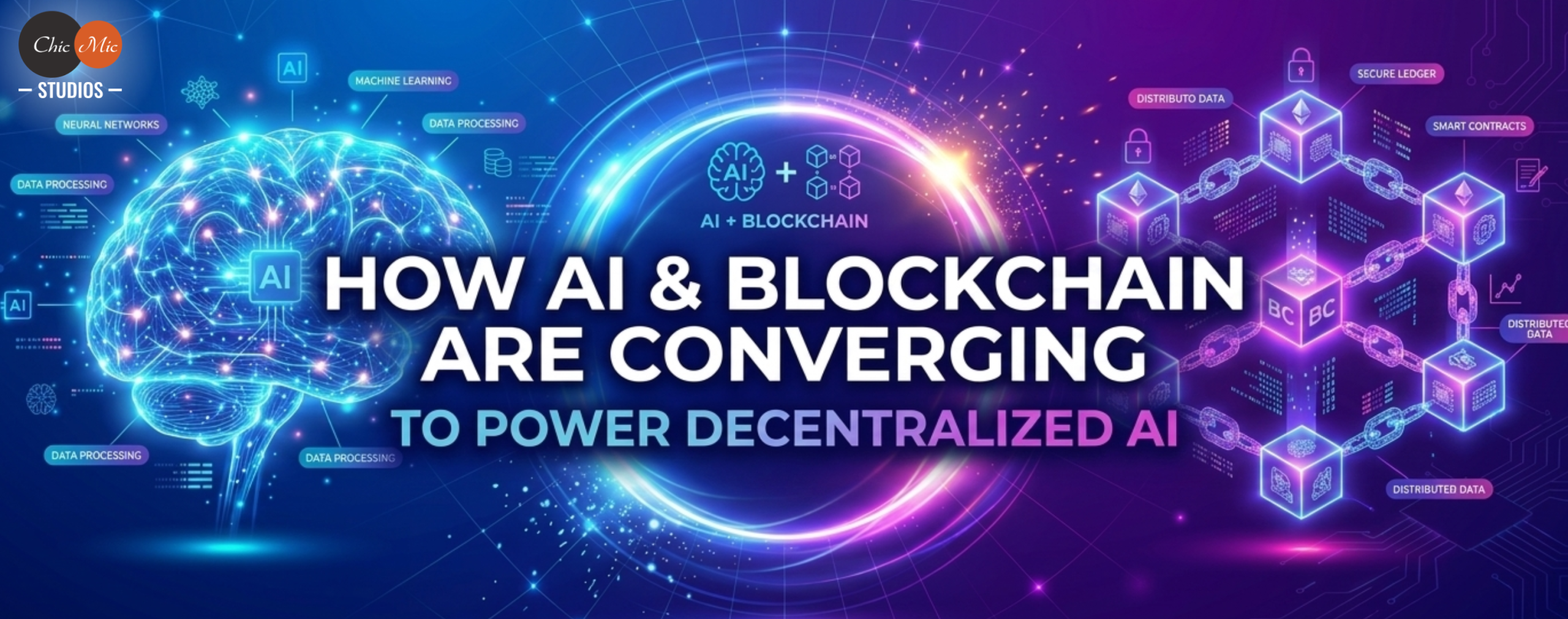
AI and blockchain are two of the most significant high-tech forces that will continue to change the way we do business today and into the future. By exploring how AI and blockchain are converging, businesses are discovering innovative methods of building systems that employ advanced analytics on trusted digital networks. The result is the creation of intelligent, secure systems that are highly distributed.
According to research from Gartner, more than 80% of enterprises are expected to adopt AI-powered automation and AI-enabled applications in the coming years, highlighting the rapid enterprise adoption of artificial intelligence. At the same time, data from Statista indicates that global spending on blockchain solutions is projected to exceed $19 billion, reflecting the growing investment in decentralized technologies. Together, these trends demonstrate why the convergence of AI and blockchain is becoming a major focus for organizations building next-generation digital systems.
With AI providing analysis of data, the recognition of patterns, and the ability to make intelligent decisions, and blockchain providing decentralised systems that allow for transparency, immutability & trust, both will continue to evolve and grow in size and ability.
Individually, these technologies have already transformed many industries. AI has powered things like automation, predictive analytics and enhanced decisioning in various industries (healthcare, finance, retail, manufacturing). While blockchain has led to things like decentralised finance, digital asset ownership and secure information sharing.
Nonetheless, the most significant change will come from how these two technologies intersect. There is an emerging shift from traditional intelligence to decentralised intelligence as a result of how AI and blockchain are converging. Today, developers and organizations are building solutions where the analytical capabilities of AI operate on the trusted infrastructure of blockchain. They are building solutions that can operate transparently, securely and without a centralised entity to control them.
The intersection of AI and blockchain is being introduced in new digital ecosystems where ownership of data exists, algorithms can be audited, and all participants work together via decentralised networks. Additionally, the intersection of these technologies is leading to the creation of decentralised platforms and secure data marketplaces, as well as the creation of autonomous digital organisations that can function with little or no human involvement.
As industry continues to investigate the integration of AI and blockchain, the way that digital systems are designed, managed and trusted will potentially be changed forever through this relationship.
What Is AI and Blockchain Convergence ?
Convergence of blockchain and AI is the combination of decentralized blockchain-based infrastructures with artificial intelligence. The end result is a system that makes it possible for intelligent algorithms to operate in secure, transparent, and distributed environments.
Traditionally, centralized infrastructures have been relied upon heavily by AI systems. For example, large businesses use large datasets; build, train, and validate machine-learning-based models; and control their decision-making processes by themselves. This type of centralized structure can create significant issues regarding transparency, bias, ownership of data, privacy, security, etc.
Blockchain’s model is different. With blockchain, data is distributed among many different nodes, rather than kept at a central location. All transactions and records that are created within a blockchain network are verified by the participants in that network and are stored in an immutable ledger. For a deeper understanding of how decentralized ledgers function, this guide on blockchain technology provides a detailed overview.
By combining AI and blockchain technologies, decentralized AI ecosystems can be created in which:
- Verifiable and securely shareable data exists across participants.
- AI models can be built and validated collaboratively using the datasets from a distributed network.
- Transaction and decision-making records can be maintained and are verifiable.
- All data contributors (and the contributors of any components of the AI process) are able to retain rights of ownership over their data.
This convergence has produced a new generation of decentralized AI platforms built on blockchain. This has the potential to reduce the monopoly power of centralized providers of AI and create the opportunity for collaborative innovation.
In these ecosystems, developers, organizations, and data contributors participate in open networks rather than closed corporate governed environments. Blockchain creates the trust and transparency needed. AI creates the efficiency and intelligence needed to automate business processes.
Why AI Needs Blockchain ?
Trust, data integrity, and governance are foundational to AI systems, but there are several limitations to the traditional AI model with respect to transparency, and accountability. However, the issues of AI are addressed in many instances by blockchain technology.
Data Integrity and Verification
AI models depend on multiple sources of data to perform well. Verifying the data’s authenticity and origin is extremely difficult. With the use of a blockchain, once data has been put into the ledger, it is impossible to change.
Because of this unique feature of immutability of the blockchain, AI provides the ability for stakeholders to independently verify where the data originated and how it was used in the training of the AI model.
Transparency in Algorithmic Decisions
The ‘black box’ issue is the largest issue with respect to AI. Many AI models’ decisions are difficult to interpret for humans. Which is why discussions around AI transparency and responsible AI development have become increasingly important.
Blockchain technology will enhance how blockchain improves AI transparency by providing a means to record, audit, and receive feedback about training data sources, algorithm updates, and AI model decisions. This provides a means for regulators and auditors to determine how an AI model evolves and its decision-making process.
Secure Data Sharing
Many companies do not wish to share datasets because of privacy issues or competition. Blockchain provides a secure data-sharing framework that allows participants to collaborate without losing control of their data.
In these environments, the use of inexpensive and easily used decentralized platforms and applications enables organizations to contribute to AI data marketplaces employing Blockchain technology. By allowing contributors to retain ownership and receive compensation for the contributed datasets, it provides an incentive for them to do so.
Fair Data Monetization
Users generate data in the traditional AI ecosystem, but they do not reap the rewards of the data’s economic value. Blockchain introduces a tokenized incentive structure, where participants can receive rewards for sharing data and/or computing resources.
Why Blockchain Needs AI ?
Blockchain technologies offer secure and transparent environments but still face some obstacles to their operational efficiency. AI is one of the means by which these limitations can be resolved due to its ability to automate processes, improve efficiency, and make intelligent decisions.
Network Optimization
The performance of a blockchain network must be reviewed continuously in order to maintain quality. By analyzing activity within blockchain networks using AI algorithms, systems can optimize transaction processing and reduce latency.
Security & Fraud Detection
Artificial Intelligence has exhibited a unique ability to identify unique patterns of activity among very large data sets. By evaluating the transactions contained within a blockchain network (data set), AI technology can identify behaviours that would indicate possible fraudulent acts and provide additional layers of security for the network.
Intelligent Smart Contracts
Smart contracts are self-executing contracts created as a part of the code written onto the blockchain. Traditional smart contracts are limited by their ability to work only when predetermined conditions are met.
AI technology can enhance traditional smart contracts by enabling them to make decisions using real-time data inputs, as it will permit smart contracts to make decisions based on real-time data being fed into the smart contract, enabling more advanced decentralized applications and automated workflows.
Governance Automation
Decentralised governance models are emerging in abundance in various blockchain ecosystems. AI-driven analytic tools will assist in evaluating the quality of proposals, predicting the outcomes of proposals, thereby providing more informed decision support within AI powered decentralized autonomous organizations.
These intelligent governance solutions will make decentralised systems much more efficient and responsive than before.
Key Benefits of AI & Blockchain Integration
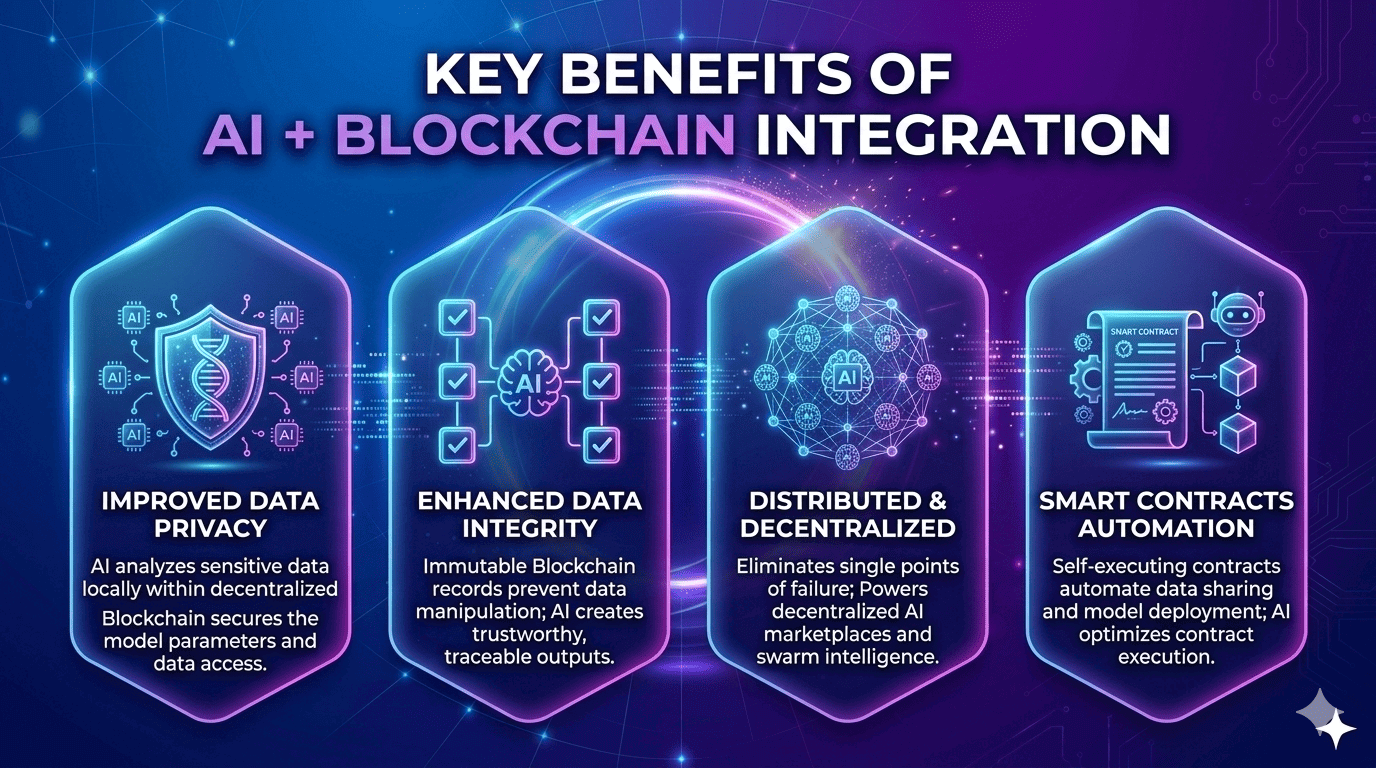
The combination of Artificial Intelligence (AI) and blockchain provides organizations with several strategic benefits in their digital ecosystems.
1. Increased Trust and Transparency
Using blockchain’s immutable records means that all data used in developing, training and applying AI (i.e., data usage, model training and decision-making) is traceable and can be validated. This creates an overall greater level of trust in an AI system’s reliability.
2. Collaborative Innovation in Decentralized Models
Using decentralized (blockchain) models allows organizations and researchers collaborating on AI to collaborate while maintaining control of their data.
3. Autonomous Digital Ecosystems
Governance frameworks governing AI development on the blockchain give rise to a digital ecosystem where AI can operate independently and autonomously (with no human direction). Such digital ecosystems also support automatic transaction processing (using AI), decentralized decision-making and AI-based intelligent decision-making.
4. Incentives That Drive Innovation
It is common practice to use token-based reward systems in blockchain networks In many token-based blockchain ecosystems, digital tokens are created to reward users for contributing valuable datasets, computing power, or AI models.
This motivates developers, data providers and infrastructure contributors to create/support AI with the incentive of earning tokens.
5. Scalable Infrastructure Supporting AI
The ability to use blockchain infrastructure for AI agents (autonomous software programs) is a key strategic benefit of integrating AI and blockchain. These agents can use blockchain to conduct business, transfer data, make decisions, and complete transactions on decentralized networks.
Real-World Use Cases of Decentralized AI
The integration of artificial intelligence (AI) and blockchain technology is already transforming multiple industries.
Healthcare Data Collaboration
Strict regulations in the healthcare industry can make it difficult to share patient data with other healthcare organizations. Because blockchain allows for the secure storage of data as well as controlled access to that data, it enables hospitals and researchers to collaborate on studies without compromising the privacy of patients.
If AI models are trained using medical data that is shared across many different hospitals, then researchers can use this new model to find diseases more quickly and accurately develop treatments. This approach supports global healthcare AI research initiatives that focus on improving diagnostics, patient care, and medical data collaboration.
Supply Chain Optimization
In addition to providing transparent tracking of inventory through the entire supply chain, blockchain technology allows for real-time analysis of supply chain data. Using these two technologies together enables companies to build intelligent supply chain systems to optimize logistics, reduce delays, and improve resource allocation.
Decentralized Finance
Artificial intelligence uses market data to create financial strategies. Blockchain technology provides the verification and transparency necessary for those strategies to be successful. The combination of AI and blockchain technology is enabling the creation of decentralized finance ecosystems where intelligent systems execute trading strategies, perform risk assessment, and manage investment portfolios.
Autonomous Organizations
One form of a new type of governance model is through AI powered decentralized autonomous organization development, where blockchain-based voting systems and AI analytics help manage operations without centralized leadership.
DAOs allow all members of that organization to participate in decisions about governance. While an algorithm is used to provide assistance with proposal analysis and the optimization of outcomes.
Decentralized AI Platforms and Ecosystems
Many emerging ecosystems are developing distributed systems in relation to AI. The goal of these networks is to establish an open platform for developers, researchers, and organizations to build artificial intelligence together. Free from dependence on centralized providers.
Some of these efforts include the development of AI distributed computing platforms using a decentralized blockchain utility. This allows both distributed computing resources to be used for the training and deployment of artificial intelligence. Other initiatives focus on the creation of AI and blockchain data marketplaces using tokenized frameworks allowing users to trade in datasets and earn rewards for their participation.
All 4 types of participants in this ecosystem include:
- Developers who contribute algorithms, architectures, and models for artificial intelligence.
- Data providers who share datasets but keep ownership.
- Infrastructure providers who offer computational resources.
- Users who utilize the decentralized applications (DApps) to access artificial intelligence.
The blockchain provides a complete record of all interactions in the ecosystem by providing transparent records. These records are of when and how contributions were made to the ecosystem and provide a mechanism to distribute rewards.
This approach could lead to the development of a global, AI network of autonomous agents that cooperate and collaborate via the decentralized digital economy.
Challenges of AI Blockchain Integration
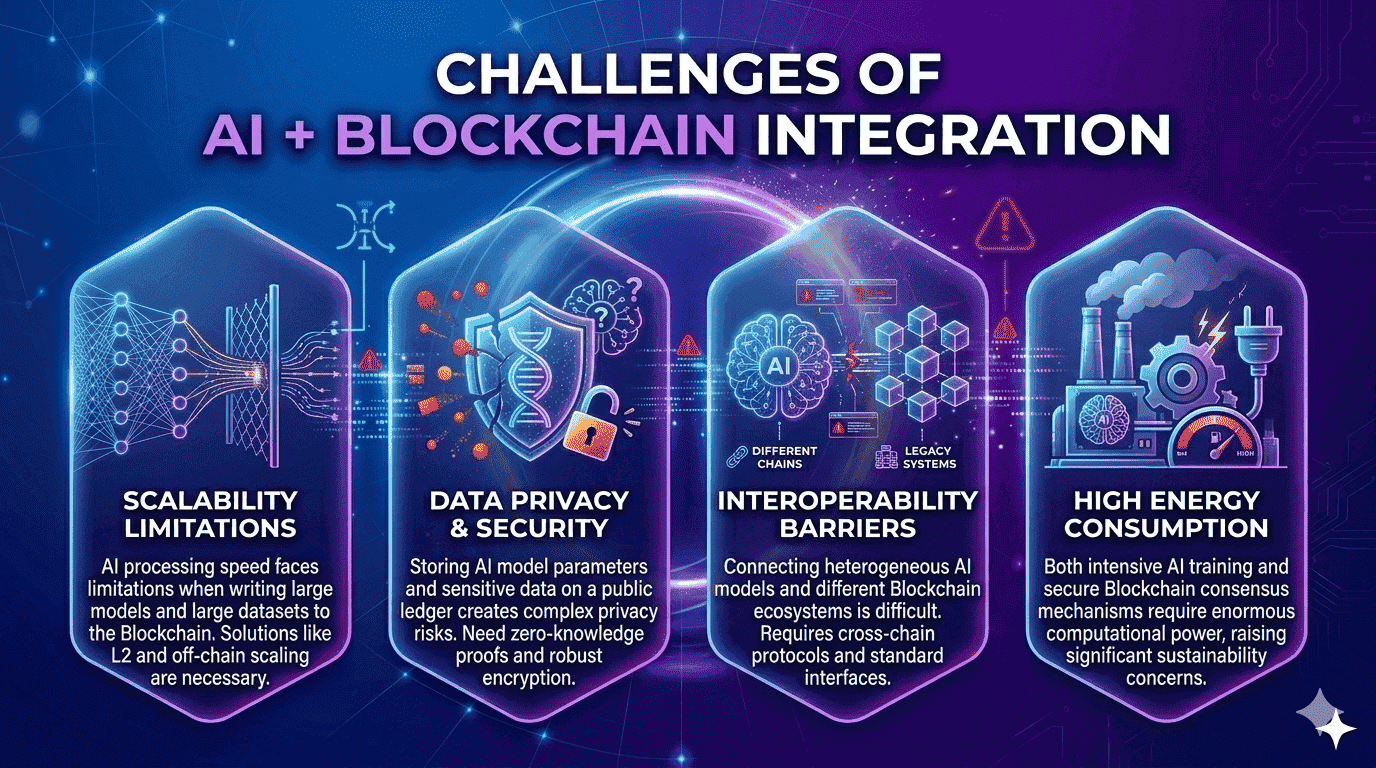
While AI offers great possibilities, there are many obstacles to successfully integrating AI onto blockchain networks. The main obstacle is that blockchain networks generally operate at a much slower rate with smaller storage capacities than AI systems. So both types of systems cannot easily coexist in a manner that achieves the fundamental purpose of each.
Data privacy and compliance with all laws and regulations is another major concern. Storing sensitive data on an immutable ledger raises privacy and compliance concerns for many people. Many developers are exploring encrypted computation and privacy-preserving cryptography research to protect sensitive information while still enabling decentralized AI collaboration.
Adoption can be hindered by the complexity of developing new solutions due to the need for expert knowledge. Because of this, the development time and cost also, typically, will increase with adoption. Finally, a lack of sufficient regulation will continue to present many obstacles as the majority of governments have not finished writing laws and regulations that govern both AI and blockchain technologies.
Future of AI and Blockchain Convergence
The future of integrating AI and blockchain technology together has fundamentally changed the way digital systems will function.
As research and development on new technologies will continue to evolve, these technologies may also be the foundation of the next generation of the internet.
The speed at which distributed computing, cryptography and machine learning will progress is going to significantly impact how quickly AI/blockchain integration is achieved. Emerging methods and technologies such as federated learning and decentralized storage networks will provide further support for successfully integrating AI with blockchain networks.
Ultimately, organizations will deploy intelligent software agents operating on decentralized networks. This will interact through the blockchain infrastructure using AI agents. in order to create a collaborative and autonomous environment within which agents will be able to share data, negotiate about services provided, and autonomously execute transactions.
Frequently Asked Questions
1. What does it mean when AI and blockchain converge?
Convergence of AI and blockchain platforms together makes it possible for developers to create applications that utilize smart contracts with the security and immutability provided by a decentralized database.
2. How does blockchain improve AI transparency?
The use of blockchain technology enables organizations to observe AI’s dataset management processes & models for accuracy, validation, and stability based on previously recorded information. These include used datasets, training model processes, and changes made to algorithms.
3. What are decentralized AI platforms built on blockchain?
Decentralized AI Platforms built on blockchain technology allow organizations, data-owners to collaborate on the development and deployment of AI algorithms/models using a transparent methodology where all parties involved will have access to information about their contributions (in terms of functionalities/code/data).
4. What industries can benefit from AI and blockchain integration?
Healthcare, financial services, supply chain, and anti cybersecurity are just some of the industries that stand out as benefiting most from integrating AI & blockchain technologies together. Whereby utilizing blockchain will provide not only a means to secure and provide access to existing distributed digital systems but will also enhance how new collaborations occur within the digital ecosystem as it relates to information security/transparency between electronic digital platforms.
5. What is the future of decentralized AI systems?
There is an expectation that decentralized AI systems will significantly affect the next phase in digital Infrastructure development; due to the ability of AI to provide intelligent solutions based upon data acquired/processed from a multitude of global sources while applying the principles of “Decentralized Trust” through the use of Blockchain to enable autonomous systems to function together across all denominating networks securely.
Businesses exploring AI and blockchain integration often require expertise in smart contracts, decentralized infrastructure, and AI model deployment. Working with experienced blockchain developers can accelerate the development of decentralized AI platforms.
If your organization is exploring decentralized AI platforms, smart contracts, or blockchain-powered AI systems, the experts at ChicMic Studios can help design and develop secure, scalable solutions tailored to your business needs.